
In short: a good fleet claims provider can show you how fast claims are lodged, who handles them, what you can see at any time, and how recovery is tracked. Ask these ten questions, and look for specific answers, not general promises.
Why the choice of provider matters
Fleet claims are handled by the provider, but the cost and the disruption fall on you. A slow or unclear process means vehicles sit idle, drivers wait for decisions and costs that could have been recovered are missed. A provider also holds your claims record, which you will want at renewal and when you talk to brokers and insurers.
Most providers can describe a good process. The difference shows up in the details: how fast, who, what you can see and what is written down. The questions below are built to bring those details out.
The ten questions
- How and how fast can a claim be lodged? Good answer: by phone, online or API, within minutes, with the driver or fleet manager able to start it.
- Who handles my claims, and are they specialists in fleet? Good answer: named teams with fleet, liability and multi-vehicle experience.
- Can I see the status of every open claim at any time? Good answer: a live view of each claim, from lodgement to close.
- What service levels do you commit to, and how do you report against them? Good answer: written timeframes for contact, assessment and decisions, with alerts before a deadline is missed.
- How do you assess liability and decide who pays? Good answer: a documented process, with every decision and the reason for it kept on file.
- How do you pursue recovery from at-fault parties? Good answer: recovery is flagged at intake and tracked to the end, with results reported.
- What reporting will I get, and how often? Good answer: monthly management reports showing cost, days to close, volumes and trends, plus the ability to ask for more.
- How do you connect to our fleet or telematics systems? Good answer: clear answers on data feeds and API intake, and what you need from us.
- How do you keep records and meet regulatory obligations? Good answer: a full audit trail and the ability to produce regulatory reports from the live file.
- What does it cost, and what is included? Good answer: a simple price, such as per vehicle per month, with anything extra stated up front.
Why these questions
Lodgement (question 1). Claims that start late or incompletely take longer all the way through. The first contact sets the pace.
Specialists (question 2). A team that mostly handles private motor claims may not be familiar with multi-vehicle incidents, commercial liability or company driver issues.
Visibility and service levels (questions 3 and 4). If you cannot see claim status, you will ring to ask. If service levels are not written down, they cannot be measured or enforced.
Liability and recovery (questions 5 and 6). These decide how much the claim costs you in the end. A provider that documents its decisions and tracks recovery protects your money and your claims record.
Reporting, systems and compliance (questions 7 to 9). Reporting turns claims into decisions about drivers, vehicles and safety. Systems and records make sure the arrangement works with your own tools and stands up if it is questioned later.
Price (question 10). A low headline price can hide extras. Ask what is included and what is charged separately.
How to run the comparison
- Write down what matters to you. Fleet size, vehicle types, locations, current claims volume and what frustrates you today.
- Send the same ten questions in writing to each provider, so you compare like with like.
- Ask for evidence. A sample monthly report, a view of the claims system, and the written service levels.
- Ask for references from customers with a similar fleet, and call them.
- Test the process. Ask how a claim would run from the first call, and who you would speak to at each step.
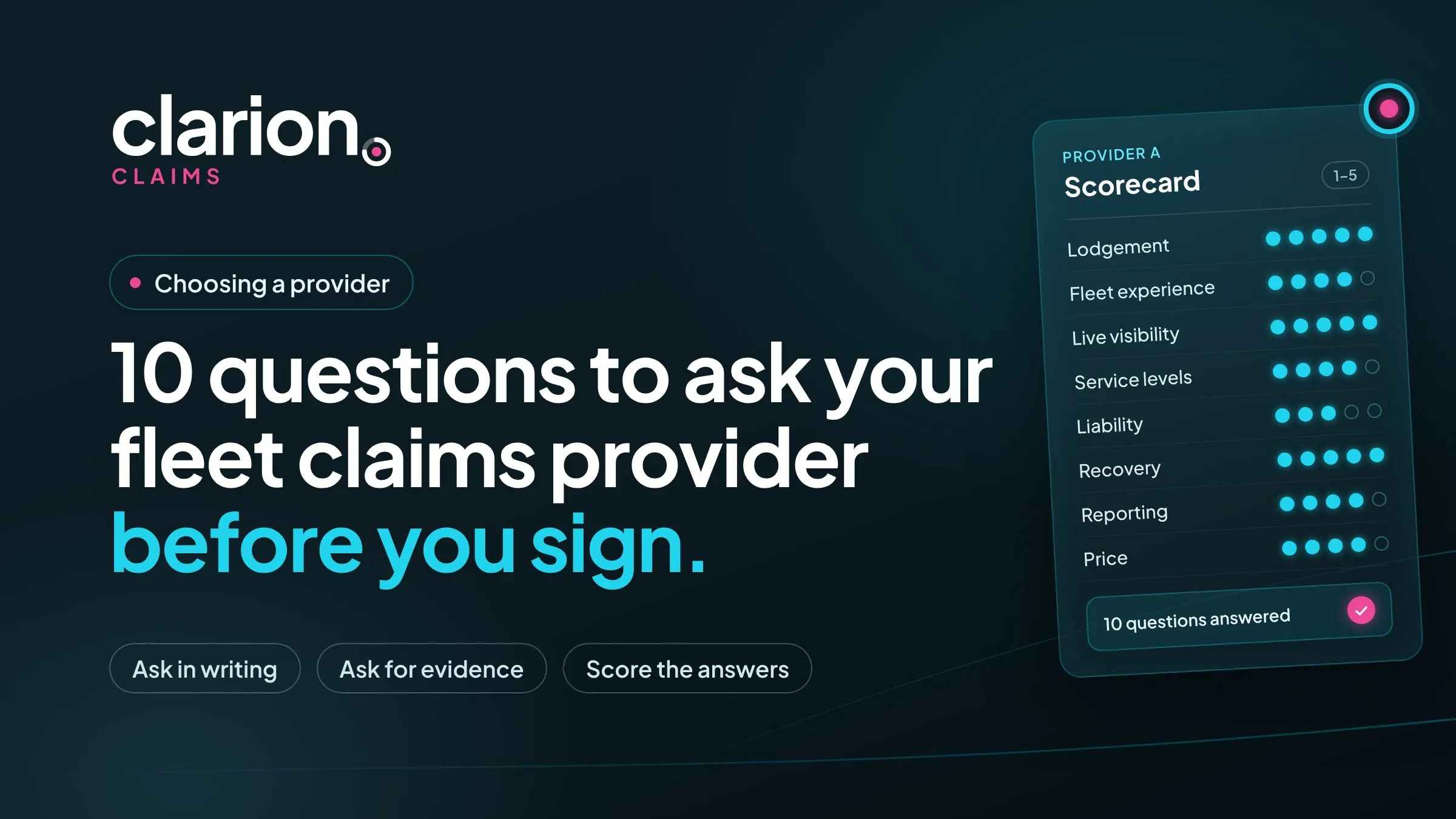
- Score the answers. Use the scorecard below and decide together with finance and safety.
Red flags
- Answers about "our process" with no numbers or timeframes
- No live view of claims for you or your drivers
- Reporting only on request, or only at year end
- No clear owner for recovery
- Fees that depend on the type of claim and are not written down
A simple scorecard
Score each provider from 1 (weak) to 5 (strong) and add notes.
| Area | Provider A | Provider B | Provider C | Notes |
|---|---|---|---|---|
| Lodgement speed and ease | ||||
| Fleet experience | ||||
| Live claim visibility | ||||
| Written service levels | ||||
| Liability process | ||||
| Recovery | ||||
| Reporting | ||||
| Systems and data | ||||
| Records and compliance | ||||
| Price and what is included |
Words you will hear
- Service level (SLA): a written commitment on timing, such as how quickly a claim is acknowledged or assessed.
- TPA: third party administrator, a company that handles claims for someone else.
- Liability: who is legally responsible for the accident and its costs.
- Recovery: claiming costs back from the party responsible.
- Audit trail: a time-stamped record of every action and decision on a claim.
- API: a way for two systems to exchange data automatically.
- Telematics: vehicle devices that record location, speed and driving behaviour.
Frequently asked questions
What does a fleet claims provider do? It takes in claims, assesses them, arranges repairs, decides liability and chases recovery, then reports on all of it.
What is the difference between a claims provider and my insurer? The insurer carries the risk. A claims provider can manage the claims for the insurer or for the fleet owner. Ask who is responsible for each step.
How many providers should I compare? Two or three is enough. Ask each the same ten questions and compare the answers side by side.
What should I ask to see before I sign? A sample monthly report, a live view of claims, and the written service levels.
Does a provider need a licence? Requirements depend on the services offered. Ask which licences and approvals the provider holds and what they cover.
Author:
Tetiana George, CEO of Curium, Co-Chair of Insurtech Australia and member of ASIC Digital Finance Advisory Committee. LinkedIn Profile.